Salisbury Musick logo
menu

What's On

Please note that Priority Booking runs until the end of May.  During this period tickets are only available online and anyone can browse events and add them to their basket, but only Friends will be able to purchase them.  You can sign up as a Friend as part of the checkout process.

Your currently selected events will be stored in your browser, and you can come back to this page later to add more.  However, only when you complete your purchase will the tickets be guaranteed.  When only a small number of tickets remain for an event, you will see a warning for this when you view your basket.


Unticketed events: concerts by local musicians in various venues. Free entry with retiring collection.


Ticketed events: talks, walk, concerts by visiting experts and meals.

Hover over the picture for an event to get a precis of the event, and click for further information and to buy tickets for ticketed events. On a mobile device, tap on a picture once for the precis and tap again for further information and tickets. You can use the filter below to limit the events you see, if this is helpful.


Saturday 3 October 2026
Down Your Way
10.30–11.15
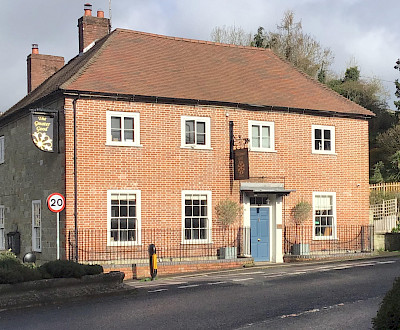
The Greater Good, Fovant
Nadder Baroque play music from around the British Isles in a pub near Salisbury.

The Greater Good in Fovant

Nadder Baroque - two violins, a cello and a spinet - will bring baroque chamber music music from all around the British Isles to a pub near you. 

Much music in the British Isles in the 17th and 18th centuries was composed in London. This is hardly surprising with the influence in the capital city of the court, the church and the theatre. But there was a vigorous musical life around Britain and this will be highlighted in this concert.

Scottish, Irish and Welsh composers will be featured alongside a composer from Newcastle and even one born just a couple of miles down the road from the pub where we will be playing.

Violins: Lynn Menzies and Pauline Gallear, Cello: David Copus, Spinet: David Davies

This is a free event but places are limited.  Please reserve a place by following a link to appear here shortly.  

Coffee and cake will be available to purchase at the pub after the concert.  

Nadder Baroque - two violins, a cello and a spinet - will bring baroque chamber music music from all around the British Isles to a pub near you. 

Much music in the British Isles in the 17th and 18th centuries ...

Click here for further details.

Madrigals of Love and Nature
10.30–11.15
Friends' Meeting House, Salisbury
The Halcyon Singers take us on a musical and poetic tour of the natural world and the not always happy realm of love.

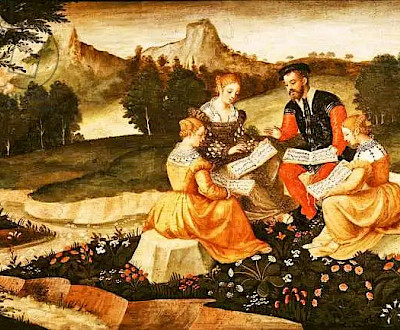
The rustic concert - a song

The English madrigalists of the renaissance and baroque were obsessed with texts about love and nature. The Halcyon Singers take us on a musical and poetic tour of the natural world, and of the not always happy world of love. Nymphs and shepherds inevitably feature, as do birds and bees – and ever so many double entendres.

Coffee and cake will be served after the concert. 

This event is unticketed, with free entry and retiring collection for those who would like to make a contribution.

The English madrigalists of the renaissance and baroque were obsessed with texts about love and nature. The Halcyon Singers take us on a musical and poetic tour of the natural world, and of the not always happy world of love. ...

Click here for further details.

Bach and his Friends
12.30–13.15
All Saints' Church, Broad Chalke
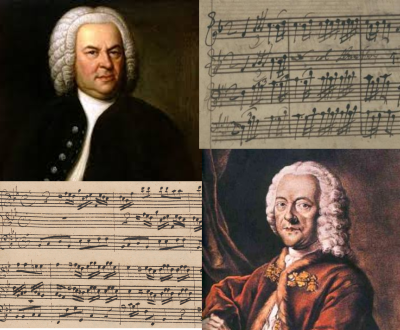
Featuring violin, recorder, oboe, bassoon and harpsichord, this programme includes works by Bach and three people we know he admired: Stölzel, Telemann and Zelenka.

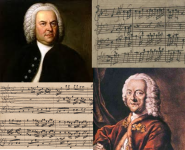
Bach, Telemann and manuscripts by Stölzel and Zelenka

We know Bach as composer of some of the most amazing music but who was he friends with and whose music did he admire? He performed music by Stölzel and Zelenka at Leipzig and Telemann was godfather to one of his sons. This concert brings together pieces for oboe, recorder, violin, bassoon and continuo by this remarkable group of contemporaries.

James Watts (baroque oboe), Miranda Dodd (baroque violin and recorder), Matthew Dodd (baroque bassoon) and Warwick Cole (harpsichord). 

This event is unticketed, with free entry and retiring collection for those who would like to make a contribution.

We know Bach as composer of some of the most amazing music but who was he friends with and whose music did he admire? He performed music by Stölzel and Zelenka at Leipzig and Telemann was godfather to one of ...

Click here for further details.

If Music be the Food of Love
12.30–13.15
St Thomas's Church
The Close Consort, with Abigail and Richard Hooper present songs, dances and consort pieces by 17th century English composers.

Close Consort logo

The Close Consort of recorders present a programme of songs, dances and consort pieces by 17th century English composers from William Byrd to Henry Purcell including Peter Philips, Robert Parsons and Anthony Holborne.

The Consort are joined by soprano and bass, Abigail and Richard Hooper to perform love songs including from John Dowland’s Books of Songs and Henry Purcell’s setting of Spenser’s poem, The Faerie Queene, amongst others.

This event is unticketed, with free entry and retiring collection for those who would like to make a contribution.

The Close Consort of recorders present a programme of songs, dances and consort pieces by 17th century English composers from William Byrd to Henry Purcell including Peter Philips, Robert Parsons and Anthony Holborne.

The Consort are joined by soprano and ...

Click here for further details.

The Musical Soul – the history of the violin bow
14.30–15.15
The Salisbury Museum
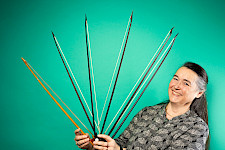
In this talk, our Patron, Margaret Faultless, explores the fascinating relationship between composers and instrumental technology by looking at the development of the violin bow.


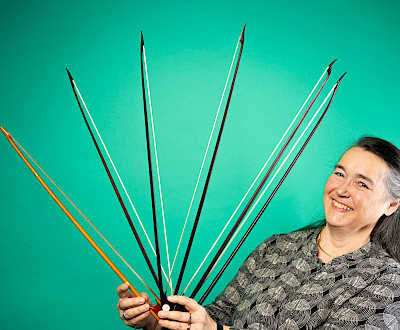
Margaret Faultless with 6 bows

The relation between composers and instrumental technology, is a chicken and egg question - which comes first? Composers developing, extending and changing the nature of musical expression or instrument and bow makers developing the technologies of instruments for performers to play. Maggie Faultless explores this fascinating relationship, discussing the changes in the violin bow (described as the soul of the music by many composers) over the centuries.

Violinist Margaret Faultless performs music from Monteverdi to the present day in a career that has included leading the contemporary music ensemble Aquarius, co-leading a West End Musical and The Scottish Ballet orchestra, and performing with ensembles such as the BBC Symphony Orchestra, the City of Birmingham Symphony Orchestra and the Academy of St Martin’s in the Fields. She has guest-led the Russian National Orchestra, the London Philharmonic Orchestra (London) and the Handel and Haydn Society (Boston). Now best known as a specialist in historical performance practice, she has held principal positions and performed with many of the best-known period instrument ensembles. As a leader of The Orchestra of the Age of Enlightenment she performs at the Proms, the South Bank, Glyndebourne and has toured all over the world.

A graduate and Honorary Fellow of Clare College, Cambridge, Musician in Residence at St John’s College and bye-fellow at Girton, she is the Artistic Director of the Cambridge University Collegium Musicum and of the University chamber music scheme (IAS), and works closely with the CMP. For 15 years Margaret was first Director of Performance at the Faculty of Music, a multi-faceted role which she helped to develop. She lectures and broadcasts on performance, her research interests including leadership and social interactions in Haydn symphonies and Bach's notation for performers.

She is the first Becket Chair of Historical Performance at The Royal Academy of Music, a Professor of the University of London and an Honorary Fellow of Birmingham Conservatoire, the city in which she grew up.

Photo courtesy of Zen Grisdale and the Orchestra of the Age of Enlightenment


The relation between composers and instrumental technology, is a chicken and egg question - which comes first? Composers developing, extending and changing the nature of musical expression or instrument and bow makers developing the technologies of instruments for performers ...

Click here for further details.

Cover Story
17.30–18.30
Medieval Hall
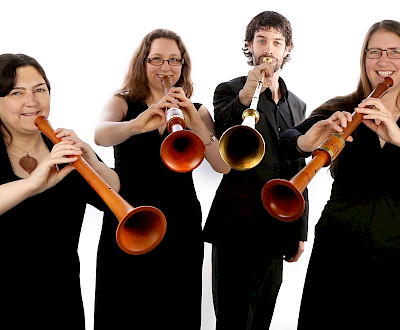
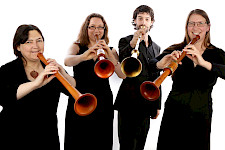
Blondel, a medieval and renaissance wind band, follow the spread of popular late medieval melodies across Europe, as they evolved over many decades.

shawms, bagpipes, slide trumpet, sackbut, recorders & percussion

Belinda Paul, Emily Baines, Lizzie Gutteridge & Daniel Serafini

Works by Machaut, Dufay, Morton, Bedyngham, Josquin, Obrecht, Paumann & more
Blondel

Cover Story tracks connections between people, places, texts and music. It follows the spread of popular late medieval melodies across Europe, as they are copied, repurposed, and evolved over many decades.

What makes a song leap across national boundaries and language barriers, slip from the secular to the ecclesiastic, and remain at the top of the charts for more than 70 years? We don’t have the formula, but we know why these pieces wedged themselves into the cultural background of medieval Europe. The music is fabulous, and audiences today love it too.

“Absolutely FAB lovely music, great explanations”
“Fantastic concert a real joy to listen to such beautiful instruments played so well”
“They say there’s a first time for everything. This was our very first time to hear live Medieval music. And what a wonderful experience. Thanks for introducing us”

More information about Cover Story can be found on our website.

Blondel is a Medieval and Renaissance wind band. Our past performances include concerts in the Cheltenham Festival (broadcast live by the BBC), Cambridge Early Music, Brighton Early Music Festival, Trolhätten Early Music Festival, Wind Works Festival Iceland, King’s Lynn Festival, Medieval Music in the Dales, Beaminster Festival, Leeds International Medieval Congress, the Wimbledon International Music Festival, Totnes Early Music Society, Barnes Music Festival, Worcester Early Music Festival, and Colchester Early Music. We have worked, both individually and as a group, for the Globe Theatre.

We were commissioned by the Agincourt600 Committee to create a work to commemorate the 600th anniversary of the battle of Agincourt—Owre Kynge Went Forth – Henry V and the Battle of Agincourt – told in words and music.The project included a gala performance, and a recording, which is available as a free download from Bandcamp

Our current project, Cover Story, has been partly funded by the Continuo Foundation. A further grant from Angel Early Music has enabled us to record this programme. The album will be released later this year.

Belinda Paul studied oboe at the VCA (University of Melbourne.). She won a scholarship to study baroque, classical and romantic oboe in the Netherlands & France with Frank de Bruine, Ku Ebbinge and Marcel Ponseele.  She has performed and recorded with The Academy of Ancient Music, the Akademie für Alte Musik Berlin, Concerto Köln, La Stagione Frankfurt, and The Australian Chamber Orchestra. Her theatre work includes performances in St Petersburg’s Hermitage Theatre, and the Utrecht Festival.

As a medieval and renaissance specialist, she has worked with I Fagiolini, The Gabrieli Consort and Players, and taken part in a number of productions at the Globe Theatre and the National Theatre. She is a founding member of Blondel, with whom she has appeared in the Cheltenham Festival, King’s Lynn Festival, Cambridge Early Music, Wimbledon International Festival and on BBC Radio 3’s In Tune and Introducing.

Dr. Emily Baines is a professional recorder player, lecturer and musical director working throughout Europe also specialising in a variety of early woodwinds. She trained at the University of Hull, the Royal Conservatory (The Hague) and the Guildhall School of Music and Drama. Emily performs regularly for many period-instrument ensembles, contemporary groups, music festivals and theatres. Theatre work has included musician/musical director roles for, English Touring Theatre, Barbican BITE, the RSC, National Theatre and Shakespeare’s Globe, including the Globe’s Broadway transfers of Twelfth Night and Richard III. Her playing is regularly featured on Radio, TV and Film. In addition to performing, Emily is a Senior Lecturer in Music at Brunel University London, and is regularly invited to other institutions for lectures and practical workshops. Her first album as a soloist (with ensemble Amyas) ‘The Ghost in the Machine’, was released in October 2021 with First Hand Records, and a new album ‘Cover Story’ with Blondel is due for release later in 2026.

Lizzie Gutteridge plays a wide range of historical instruments, including bagpipes, recorders, curtals and fiddles. She is a member of Blondel, The York Waits and the New Cambridge Waits, and musical director of the Colchester Waits. Freelance engagements have included the Globe's “Nell Gwynn” & “The Knight of the Burning Pestle”, with Passamezzo in Morocco and London. TV appearances include “Thronecast – Gameshow of Thrones” to “A Merry Tudor Christmas with Lucy Worsley”, and live & recorded performances on bagpipe of Gregory Rose’s “Dance Macabre”. Lizzie’s solo project “Consort of 1” combines early music with the use of live looping, allowing layering of parts to throw a new light on Medieval and Renaissance melodies. Her latest project “A musical Illiad” combines ancient and improvised music on aulos and lyres with live storytelling by Clare Goodall.

Daniel Serafini is a Luxembourg-based trombonist, sackbut player and educator whose work connects early music, contemporary repertoire and teaching. A professor at the Conservatoire du Nord in Luxembourg, Daniel is recognised for his thoughtful and highly individual approach to sound. At the centre of his musical practice is the belief that differences in timbre are the foundation of music. This artistic vision is closely linked to deep listening, body awareness and yoga, which all inform his relationship to breath, resonance and presence in performance.

Alongside his teaching, Daniel regularly performs with ensembles including the Freiburger Barockorchester, B’Rock Orchestra, Ensemble Pygmalion, Gabrieli Consort, United Instruments of Lucilin, Bondel and Ensemble Seraphim. His career reflects a rare versatility, moving naturally between historical performance and contemporary expression, always with a focus on colour, sensitivity and exploration. Through both performance and pedagogy, Daniel brings a refined ear and a distinctive musical voice to every project.
shawms, bagpipes, slide trumpet, sackbut, recorders & percussion

Belinda Paul, Emily Baines, Lizzie Gutteridge & Daniel Serafini

Works by Machaut, Dufay, Morton, Bedyngham, Josquin, Obrecht, Paumann & more

Cover Story tracks connections between people, places, texts and music. It follows ...

Click here for further details.

Meal at the Rifleman's Table - Saturday
18.45–19.45
Rifleman's Table, The Close, Salisbury
Book a 2-course meal at the Rifleman's Table café

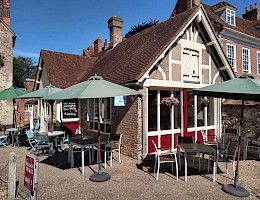
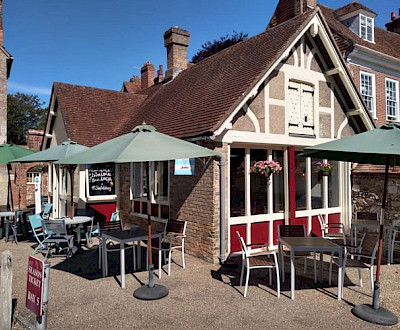
The Rifleman's TableEnjoy a meal at the Rifleman's Table café in Salisbury Cathedral Close.  They have devised a special 2-course menu for the festival and the timings are planned to fit between the two concerts.  The menu is below and you will select your meal(s) when you check out.   If you are having a meal on Friday and Saturday evenings you can select different options each evening.   When you book you will be asked to inform us about any dietary requirements and allergies.


Menu

Main course options 

  • Chicken and leek pie with new potatoes and seasonal vegetables
  • Broccoli and feta quiche with new potatoes and green leaf salad (vegetarian)
  • Farm shop sausages with mash and onion gravy
  • Chicken in white wine sauce with basmati rice and green vegetables
  • Courgette and pea risotto with shaved parmesan (vegetarian)

Dessert options

  • Traditional sherry trifle
  • Lemon posset
  • Apple and blackberry crumble tart
  • Autumn mess (pavlova, berry compote and fresh berries)

Price per person £20.  When the meal is booked together with both evening concerts, we discount the concerts by £10 if all are booked together before September 1st.  We include reserved seats for the second concert, so that you don't need to rush away from your meal.  Please note, this 'meal deal' discount cannot be combined with the discounted price for 4 or 5 concerts, and the basket will show the most advantageous discount to you.

The café has an alcohol licence so you can buy drinks separately on the night.  

Please note this will only go ahead if we reach the minimum number of bookings required for each evening.  If we are not able to go ahead you will be told at least two weeks before the date of the concert and refunded the cost of the meal.  Equally spaces are limited so book early to avoid disappointment.  

Enjoy a meal at the Rifleman's Table café in Salisbury Cathedral Close.  They have devised a special 2-course menu for the festival and the timings are planned to fit between the two concerts.  The menu is below and you will select ...

Click here for further details.

Tartini and the School of Nations
20.00–21.00
Medieval Hall
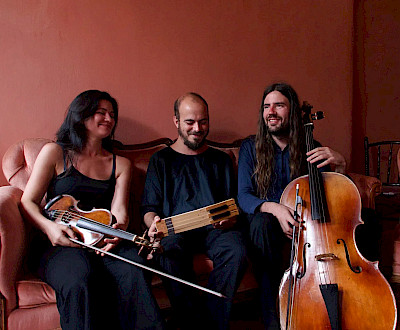
Nocturnalia’s programme explores the transcendent figure of Giuseppe Tartini, revolutionary teacher, virtuoso violinist, theorist, and composer of the Enlightenment.

Nocturnalia

Nocturnalia’s programme explores the transcendent figure of Giuseppe Tartini, revolutionary teacher, virtuoso violinist, theorist, and composer of the Enlightenment, whose musical and pedagogical influence continues to resonate.

Tartini founded the Scuola delle Nazioni (School of Nations) in Padua, where he trained generations of musicians from across Italy and Europe. Alongside his compositional career, he conducted pioneering experiments in acoustics and became a leading musical theorist. A prolific composer, Tartini laid the foundations of the galant style, bridging Baroque and Classical idioms. His works often drew inspiration from poetry, and even, dreams.

The program traces Tartini’s European legacy through his students, from Nardini to Stratico, including Pugnani and Sirmen, highlighting the international reach of the Scuola delle Nazioni. Through violin, harpsichord, and cello, these works blend melodic elegance, expressive affetti, and rich harmonic invention to move both heart and senses.

Continuo Foundation logo

We are grateful to the Continuo Foundation for their support for this concert.  


Nocturnalia Ensemble is a trio dedicated to historical performance, blending rediscovered repertoire, folk influences, and innovative programming. Our concerts create a dynamic dialogue between past and present, reviving the emotions of forgotten sounds and forging a deep connection with the audience.

We view Early Music as profoundly contemporary, embracing the freedom of improvisation and ornamentation. Our approach is shaped by our European roots and the cultural concepts that define us: Šarovít (colorful and picturesque), Duende (the creative struggle to evoke deep art), and Μεράκι (to do something with soul).

Formed during late-night sessions at the Romanesque Abbey of Ambronay in 2021 through the EEEmerging+ European Academy, Nocturnalia gave its debut concert in Athens in 2023. Subsequent appearances include the Utrecht Oude Muziek Festival, Contratemps Festival (Barcelona), Tartini Festival (Ljubljana), Chios Music Festival, and tours in Slovenia.

Selected for the BREMF Live! Scheme 2024–25 and the prestigious S-EEEmerging 2026–2027 programme, the ensemble has been supported through residencies and concerts across Europe. Upcoming and recent performances include BBC3, Torroella Festival, Helsinki Baroque Orchestra, Festival Baroque de la Tarentaise, Brighton Early Music Festival, the Foundling Museum, Salisbury Early Musick, and the Festival dei Giovani Musicisti Europei (Academia Montis Regalis).

Mojca Jerman – Violinist
Mojca Jerman specializes in Baroque and Classical music and is a recipient of the Premio Nazionale delle Arti. She performs across Europe and the Americas with ensembles including Insula Orchestra, Anima Eterna, and Frau Musika.

Pablo Tejedor-Gutiérrez – Cello & Viola da Gamba
Pablo performs on historical cello and viola da gamba with ensembles such as Holland Baroque, Instruments of Time and Truth, Academia Montis Regalis, and Ensemble Mare Nostrum. He is also an active researcher and teacher at the Royal College of Music and the University of Oxford.

Alex Mastichiadis – Harpsichord & Organ
Alex specializes in 17th–18th century repertoire and historical performance. In addition to solo and ensemble work with groups like Armonia Atenea, he explores contemporary sound art with MMMD and teaches clavichord at the Royal Conservatoire The Hague.

Nocturnalia’s programme explores the transcendent figure of Giuseppe Tartini, revolutionary teacher, virtuoso violinist, theorist, and composer of the Enlightenment, whose musical and pedagogical influence continues to resonate.

Tartini founded the Scuola delle Nazioni (School of Nations) in Padua, where he ...

Click here for further details.